

⚡ Eriskay Pony at a Glance: Key Specifications & Benchmarks
| Scientific Name | Equus caballus (Western Isles Celtic Subtype) |
| Scottish Gaelic Name | Each Innis Eirisgeidh |
| Breed Origin | Isle of Eriskay, Outer Hebrides, Scotland |
| Average Mature Height | 12.0 to 13.2 hands (48 to 54 inches / 122 to 137 cm) |
| Average Mature Weight | 650 to 850 lbs (295 to 385 kg) |
| Primary Purpose | Conservation grazing, family riding, driving, therapeutic riding |
| Predominant Coat Color | Born black, bay, or brown, progressively greying to flea-bitten white |
| Conservation Status | Critical Priority on the Rare Breeds Survival Trust (RBST) Watchlist |
The Eriskay pony represents one of the oldest, rarest, and most culturally poignant equine treasures in the British Isles. Native to the remote, storm-lashed Isle of Eriskay in the Outer Hebrides of western Scotland, this ancient Celtic pony is the last surviving descendant of the original Western Isles pony. While mainland Scottish equines were heavily crossed with larger draft breeds like the Clydesdale during the agricultural revolution, the ponies of Eriskay remained genetically isolated, preserving the pure bloodlines of prehistoric Celtic island horses. Understanding breed-specific traits helps maximize Eriskay Pony longevity and output.
Homesteaders and equine enthusiasts exploring our foundational equine management and horse husbandry resources will discover in the Eriskay pony an extraordinarily thrifty, hardy, and affectionate partner. For centuries, these ponies lived alongside Hebridean crofters, hauling heavy creels of cut peat from the moors, dragging seaweed (kelp) from the Atlantic shore to fertilize machair soils, and gently carrying crofters’ children to school.
The breed is renowned worldwide for its exceptionally gentle, calm, and empathetic temperament. Unlike spirited sports ponies, the Eriskay possesses an innate affinity for human companionship, making them world-class mounts for children, amateur riders, and therapeutic riding programs for disabled equestrians.
Today, passionate conservationists and the Eriskay Pony Society are actively safeguarding this critically endangered treasure, ensuring that its ancient genetics continue to enrich sustainable grazing landscapes.
Physical Characteristics & Breed Standards
The Eriskay pony presents a classic Celtic pony silhouette: compact, proportional, strong-boned, and built with natural athletic balance. Their low center of gravity and sure-footed balance allow them to navigate wet peat bogs, rocky coastal shores, and steep heather moors without faltering.
The head is refined, noble, and distinctly Celtic, featuring a broad forehead, straight profile, and large, kind, expressive dark eyes that radiate calm intelligence. The ears are small, neat, and mobile, lined with dense protective hair that keeps out driving Atlantic sea spray. Routine preventive care saves time and lowers veterinary costs for Eriskay Pony.
Conformation Standards & Anatomical Structure
The neck is muscular, medium in length, and carried proud, blending smoothly into deep, sloping shoulders that anchor comfortable riding gaits. The back is short, broad, and strong, with well-sprung ribs that house substantial lung capacity and an efficient digestive tract.
The hindquarters are muscular and rounded, driving powerful forward impulsion. Legs are cleanly boned with short cannons and dense, clean feathering at the fetlocks. Hooves are round, hard, and dark-shelled, naturally adapted to endure wet moorland without splitting or rotting.
Size, Weight Benchmarks & Color Variations
Mature Eriskay ponies measure between 12.0 and 13.2 hands (48 to 54 inches / 122 to 137 cm) at the withers and weigh between 650 and 850 lbs (295 to 385 kg). Despite their modest height, their deep chest and substantial bone carry adult riders with ease.
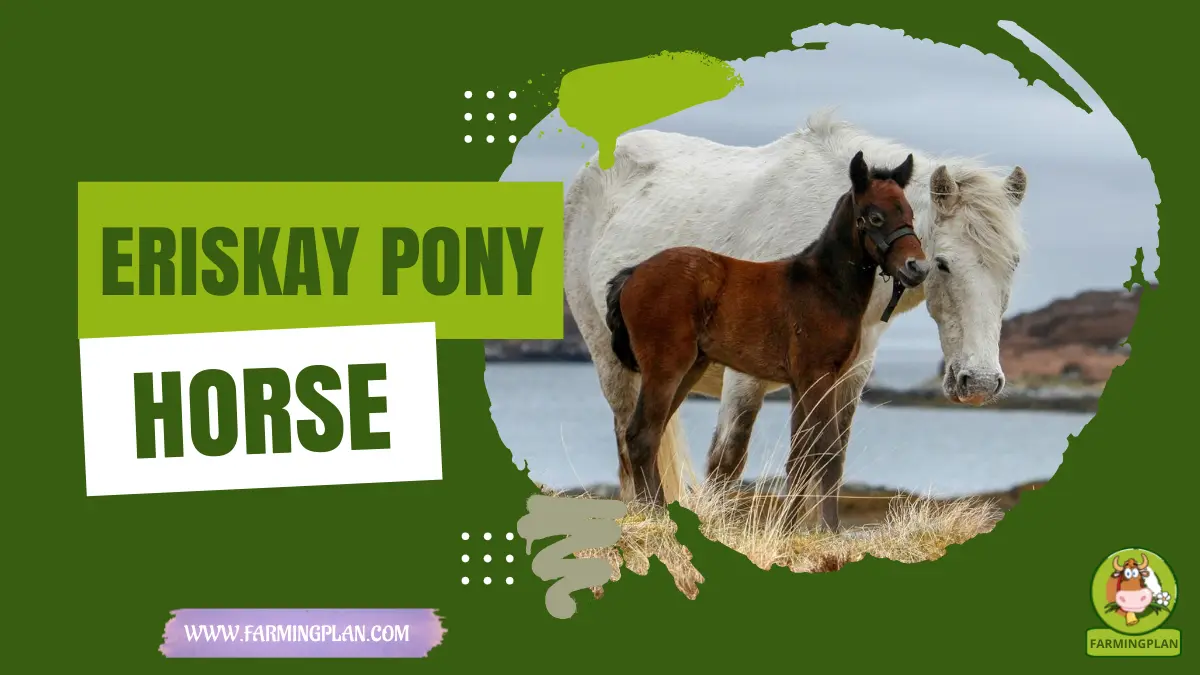
The vast majority of Eriskay ponies are born black, dark brown, or bay, progressively greying out over several years until they attain a beautiful silver-grey or flea-bitten white coat. Pure black and bay adults occur rarely, while piebald, skewbald, and chestnut are strictly disqualified under breed standards.
⚡ Eriskay Pony Performance & Production Matrix
| Equine Metric | Eriskay Pony Benchmark | Standard Riding Pony Comparison | Homestead Utility |
|---|---|---|---|
| Mature Height | 12.0 – 13.2 hands | 13.2 – 14.2 hands | Accessible mounting size for children and small adults |
| Forage Efficiency | Exceptional ‘easy keeper’ | High grain requirement | Thrives on rough pasture, native grass, and brush |
| Hoof Hardness | Extremely tough / rock-adapted | Requires frequent shoeing | Maintains strong barefoot soundness with basic trimming |
| Temperament Score | Gentle, calm, empathetic | Can be spirited / nervous | Premier choice for family riding and therapeutic programs |
| Winter Cold Hardiness | Dense double coat (waterproof) | Requires heavy blanketing | Endures winter storms outdoors with simple run-in shed |
Breed History, Heritage & North American Development
The ancient roots of the Eriskay pony trace back to the Celtic equines that roamed the British Isles prior to the Roman conquest. Pictish stone carvings across Scotland depict small, graceful ponies with similar head profiles and carrying styles, testifying to their antiquity.
On the isolated Isle of Eriskay, crofters relied entirely on their ponies for survival in a harsh, treeless environment. Because crofts were tiny and resources scarce, families could keep only the gentlest, most efficient animals. Any pony displaying aggression, stubbornness, or high feed demand was culled, creating an extraordinarily docile breed. Matching forage or ration quality to life stage optimizes Eriskay Pony growth.
By the early 1970s, mechanization and the introduction of tractors brought the breed to the brink of extinction, with fewer than 20 purebred mares remaining on the island. A dedicated team comprising local islanders, veterinarians, and scientists formed the Eriskay Pony Society in 1972, initiating genetic blood typing to secure purebred lines.
Today, while still listed as a Priority breed on the Rare Breeds Survival Trust (RBST) Watchlist, the population has grown to several hundred registered ponies across the UK, serving as celebrated heritage ambassadors and conservation grazers.
Housing, Shelter Dimensions & Winter Hardiness
Housing an Eriskay pony requires recognizing their evolutionary adaptation to open, windswept Hebridean coastal conditions. Confining these ponies in tight, warm, insulated barns is unnatural and often triggers respiratory distress and stable vices.
A well-drained pasture equipped with a three-sided run-in shed facing south or southeast provides ideal year-round shelter. Ensure the shed provides at least 12×12 feet of floor space per pony, with deep wood shavings or straw bedding during severe winter freeze cycles.
Spatial Density & Enclosure Engineering
Pasture fencing should consist of smooth post-and-rail timber, sturdy pipe panels, or high-tensile polymer wire with an interior electric offset wire at chest height. Barbed wire must never be used with equines to prevent severe lacerations.
Allocate 1.5 to 2.5 acres per pony under rotational grazing management. Because Eriskay ponies are exceptionally efficient converters of pasture sugars, rich spring pastures must be restricted using grazing muzzles or dry-lot turnout to prevent equine metabolic syndrome and laminitis. Gradual dietary transitions protect digestive stability in Eriskay Pony.
Nutritional Requirements, Daily Rations & Feeding Protocols
Eriskay ponies are legendary ‘easy keepers’ adapted to survive on coarse coastal machair grass, heather, seaweeds, and rough moorland rushes. Overfeeding commercial grain concentrates or lush clover pasture is the quickest way to ruin their health.
Comparing equine feeding in our Fell pony mountain grazing and care guide demonstrates how native British ponies thrive on low-calorie roughage. Plain grass hay and clean water form the cornerstone of their daily nutrition.
Crude Protein Benchmarks Across Life Stages
An adult Eriskay pony in light to moderate work maintains optimal body condition on a daily ration of mature, low-sugar grass hay (8% to 10% crude protein) fed at 1.5% to 2.0% of body weight (approx. 12 to 16 lbs daily). Late-cut meadow hay is preferable over rich, early-cut leafy hay.
Never feed high-starch sweet feeds or molasses mixes. If extra nutrients are needed during winter, provide an unmolassed beet pulp mash combined with a balanced low-calorie equine mineral balancer that supplies zinc, copper, and selenium.
Always ensure access to clean, fresh water and a plain white salt block. An adult pony consumes 8 to 12 gallons of water daily, increasing during summer heat or after trail work. Selecting healthy foundation stock is the cornerstone of successful Eriskay Pony management.
Health Management, Common Diseases & Biosecurity Standards
Eriskay ponies boast robust immune systems and ironclad genetic constitutions, suffering remarkably few conformational unsoundnesses. However, their primary veterinary vulnerability is laminitis (founder) caused by excessive intake of non-structural carbohydrates (sugars and starches) in lush pastures.
Equine healthcare programs should follow guidelines established by the American Association of Equine Practitioners (AAEP) to maintain core vaccination and dental care schedules.
Implement a proactive parasite control program based on seasonal fecal egg count diagnostics rather than indiscriminate rotational deworming.
Biosecurity Protocols & Veterinary Defenses
Administer annual core vaccinations covering Eastern and Western Equine Encephalomyelitis, West Nile Virus, Tetanus, and Rabies. In tick-endemic areas, check mane and tail roots regularly to prevent Lyme disease transmission.
Hoof care demands a certified farrier on a regular 6-to-8-week trim cycle. Due to their dense, rock-hard hoof walls, Eriskay ponies typically remain sound barefoot on most terrains, requiring only balanced rasping to maintain proper hoof-pastern angles.
Breeding Management, Conservation Studbooks & Foal Care
Preserving the genetic diversity of the Eriskay pony requires strict adherence to the Eriskay Pony Society studbook rules, utilizing pedigree DNA parentage verification for all breeding stock. Inbreeding coefficients are monitored to safeguard genetic vigor. Good predator-proofing and dry bedding safeguard Eriskay Pony comfort in harsh weather.
Mares reach breeding maturity at 3 to 4 years of age, possessing exceptional fertility and maternal care. Gestation lasts an average of 335 to 340 days, culminating in unassisted foaling in over 98% of deliveries.
Foals are born vigorous, standing to nurse antibody-rich colostrum within an hour of birth. Foals develop deep bonds with human handlers through early gentle imprint training, mirroring protocols outlined in our Chincoteague pony herd management guide.
US Ownership Budget & Annual Maintenance Costs
Maintaining an Eriskay pony is exceptionally economical compared to large horse breeds due to their modest feed requirements and barefoot soundness. Below is an itemized annual budget in US dollars.
💰 Estimated Annual Budget & Maintenance Costs (USD)
| Budget Category | Item Description & Scope | Initial Capital Outlay | Annual Recurring Expense |
|---|---|---|---|
| Registered Eriskay Pony | Purebred conservation breeding stock from registered lines | $2,500 – $4,500 | Initial investment |
| Tested Low-Sugar Grass Hay | 2.5 tons quality grass hay per pony annually | $300 – $500 | $400 – $650 per head |
| Equine Mineral Balancer & Salt | Low-calorie ration balancer and white salt blocks | $35 – $55 | $45 – $75 per year |
| Routine Veterinary & Core Vaccines | Annual wellness exams, dental floating, core vaccines | $150 – $250 | $180 – $300 annually |
| Farrier Trimming (Barefoot) | Routine hoof balancing every 6 to 8 weeks | $40 – $60 | $240 – $360 annually |
🧮 Eriskay Pony Daily Feed & Hay Intake Calculator
Calculate recommended daily dry grass hay (lbs), clean water intake, and estimated monthly forage costs tailored specifically for your Eriskay Pony.
Frequently Asked Questions (FAQ)
Why are Eriskay ponies so rare?
Eriskay ponies are critically rare because their native population was isolated on the Isle of Eriskay; agricultural mechanization in the 1900s reduced purebred breeding stock to fewer than 20 mares before conservation efforts began.
What color are Eriskay ponies?
Most Eriskay ponies are born black, dark brown, or bay, progressively turning grey over several years until they become silver-grey or flea-bitten white; pure black or bay adults are rare.
Can an adult ride an Eriskay pony?
Yes, despite standing 12.0 to 13.2 hands, their broad back, deep chest, and strong bone structure allow them to carry balanced small and medium-sized adult riders with ease.
Are Eriskay ponies good for children and therapy?
Yes, their extraordinarily calm, gentle, and empathetic temperament makes them one of the world’s finest ponies for children, beginners, and therapeutic riding programs.
What should I feed an Eriskay pony?
Feed mature, low-sugar grass hay and clean water; avoid rich pastures, molasses, and grain concentrates, as Eriskay ponies are efficient ‘easy keepers’ prone to laminitis on rich diets.
Expert Verdict & Next Steps for Rare Breed Guardians
The Eriskay pony is an extraordinary living piece of Celtic history, offering calm companionship, sure-footed riding, and conservation grazing in a compact, thrifty equine package. Stewarding an Eriskay pony brings immense joy while directly contributing to the survival of one of the world’s most endangered heritage breeds.
Before acquiring an Eriskay, secure horse-safe fencing, establish a dry-lot paddock for spring grazing restriction, and find a knowledgeable barefoot farrier. Comparing management practices with other hardy British native breeds like the Shetland pony care guide will help you build a safe, sustainable equine home.
📚Agricultural Reference & Scientific Citations
Standards and physiological data referenced in this guide comply with USDA Animal and Plant Health Inspection Service (APHIS), American Veterinary Medical Association (AVMA), and the FAO Domestic Animal Diversity Information System.


