

⚡ Balinese Cat at a Glance: Key Specifications & Benchmarks
| Scientific Classification | Felis catus (Domestic longhair point mutation of Siamese) |
| Breed Origin & Development | United States (Spontaneous longhair mutation registered 1950s) |
| Adult Body Weight | Males: 8 to 12 lbs (3.6 to 5.4 kg); Females: 6 to 9 lbs (2.7 to 4.1 kg) |
| Coat Type & Undercoat | Single-layer semi-long silky coat without a woolly undercoat |
| Hypoallergenic Status | Produces significantly lower levels of salivary Fel d 1 protein |
| Activity & Temperament | Highly athletic, inquisitive, acrobatic, vocal, and deeply bonded |
| Average Lifespan | 14 to 20 years with proper feline veterinary wellness care |
| Homestead Vermin Aptitude | Swift mousing reflexes suitable for enclosed stables and dwellings |
The Balinese cat combines the lithe grace of the Siamese with a flowing, single-layer coat that catches the eye of homesteaders and companion animal lovers alike. Originating in the United States as a natural mutation within purebred Siamese litters, this breed earned its romantic moniker from early breeders who compared its fluid locomotion to the graceful dancers of Bali. Monitoring water quality and mineral balance directly benefits Balinese Cat vitality.
Unlike standard longhaired felines burdened by thick woolly undercoats that mat easily in rural environments, the Balinese features a sleek single coat. This unique trait makes coat upkeep remarkably straightforward. For homesteaders exploring our feline breed and homestead cat care guides, understanding this structural advantage helps keep grooming manageable while maintaining a pristine farmstead companion. Practical hands-on husbandry ensures consistent results when raising Balinese Cat.
Balinese cats also attract widespread attention from allergic animal keepers because clinical research demonstrates lower production of the primary feline allergen protein, Fel d 1. This characteristic allows many allergy-sensitive individuals to welcome a vibrant indoor hunter and loyal companion into their rural residences.
However, rural owners must recognize that Balinese cats are not docile lap ornaments. They possess athletic musculature, demanding mental engagement, and vocal communication styles that insist on daily human interaction. They thrive in active farm households where their curiosity and energetic pursuit of stray mice find productive outlets. Early intervention at the first sign of lethargy protects overall Balinese Cat flock or herd health.
Physical Characteristics & Breed Standards
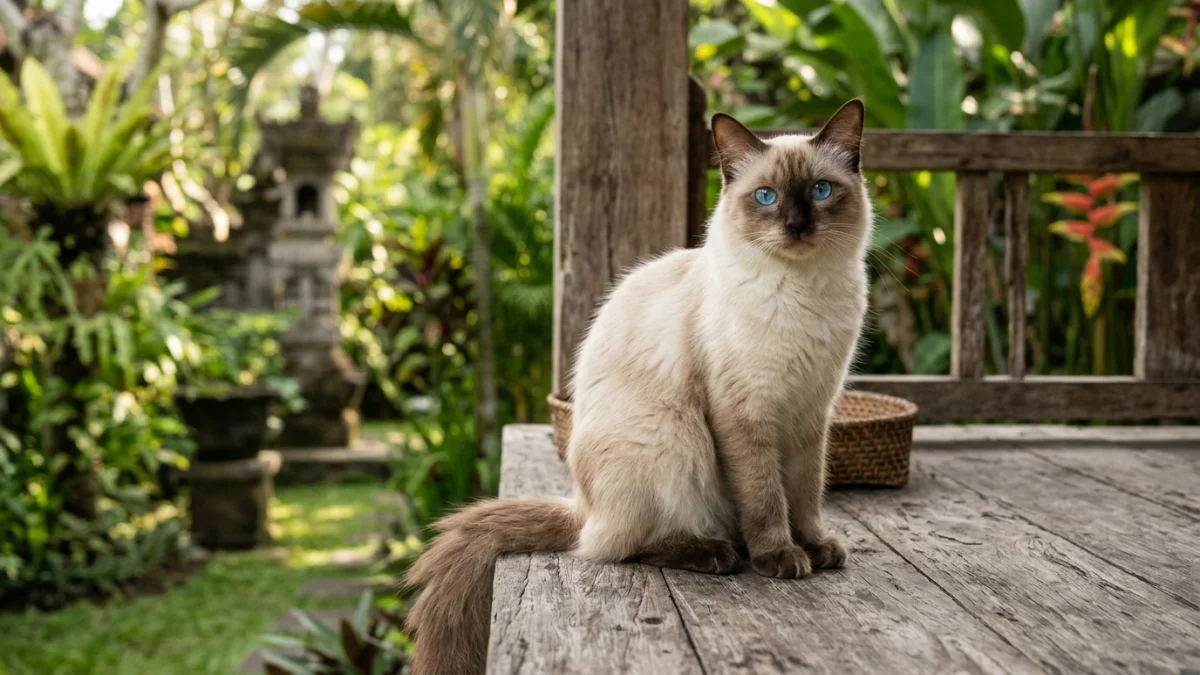
The Balinese standard demands svelte elegance anchored by firm tubular muscularity. Underneath their fine, feathery coat lies a lithe bone structure that enables vertical leaps surpassing six feet with negligible effort. The body profile forms a continuous long cylinder supported by slim, refined legs with delicate oval paws. Structured culling and biosecurity protocols strengthen Balinese Cat genetic quality.
Cranial Conformation & Point Pigmentation
The Cat Fanciers Association (CFA) recognizes the traditional wedge-shaped head with broad-based ears continuing the straight line from jaw to tips. The eyes are almond-shaped, set at a slight oriental slant, and must exhibit deep, vivid sapphire blue coloration. Any squinting or pale washed-out hue represents a fault in registered lines.
Point coloration restricts intense melanin pigmentation to the mask, ears, distal legs, and plumed tail, contrasting against an off-white or cream torso. Recognized color variations include seal point, chocolate point, blue point, and lilac point. Red, cream, and tortoiseshell points are classified as Javanese in certain breed registries. Maintaining clean feeders and sanitized equipment supports sustainable Balinese Cat care.
⚡ Balinese Cat Performance & Production Matrix
| Color Class | Genotype Expression | Grooming Frequency | Homestead Hunting Vigor |
|---|---|---|---|
| Seal Point | Dark sable points on pale fawn body | Weekly brushing (low matting) | High predatory drive against mice & moths |
| Chocolate Point | Warm milk chocolate on ivory field | Weekly combing (minimal shed) | Moderate agile tracking in barns & houses |
| Blue Point | Slate grey-blue points on platinum torso | Twice weekly soft bristle brush | Persistent ambush hunter of indoor pests |
| Lilac Point | Frosty lavender-pink on clear white coat | Weekly grooming; zero undercoat | Playful stalker; sensitive to extreme cold |
Breed History, Heritage & North American Development
Longhaired kittens occasionally appeared in standard Siamese litters throughout the early 20th century. Traditional breeders initially culled or quietly placed these longhaired anomalies in pet homes, considering the recessive longhair gene a contaminating defect. During the 1950s, visionary breeders Marion Dorsey in California and Helen Smith in New York recognized their refined beauty. Consistent daily observation helps keepers spot early changes in Balinese Cat health and behavior.
Rather than relying on outcrosses to Persian stock, Dorsey and Smith bred only purebred Siamese carrying the recessive mutation. This deliberate breeding decision preserved the authentic tubular body geometry and high intelligence of the ancestral breed while yielding an entirely new semi-longhaired show cat.
The Cat Fanciers Association granted championship status to the Balinese in 1970. Today, the International Cat Association (TICA) and European federations celebrate the breed for its genetic purity. Homesteaders admire how these historic genetics preserve sharp working instincts alongside sweet domestic temperament. Clean housing, fresh water, and balanced nutrition remain essential for Balinese Cat productivity.
Modern breeding lines maintain strict studbooks to avoid inbreeding depression while safeguarding the distinctive single coat. This rigorous pedigree maintenance shields the breed from heavy woolly coats that collect hay burs and farm dust, keeping their physical maintenance remarkably low. Tracking feed intake and body condition supports long-term Balinese Cat performance.
Housing, Shelter Dimensions & Winter Hardiness
Due to the absence of a dense insulating undercoat, Balinese cats are vulnerable to thermal stress during freezing weather. They must be maintained primarily as indoor farmstead companions or provided with temperature-regulated barn offices rather than exposed to unheated outdoor stables during northern winter months.
Environmental Enrichment & Spatial Hierarchy
Balinese cats require three-dimensional vertical space to express natural predatory behaviors and relieve psychological tension. Install wall-mounted catwalks, sisal climbing towers reaching 7 to 8 feet, and safe window perches overlooking farm pastures. Bored Balinese cats frequently invent destructive games, including emptying cupboards and unraveling paper goods. Following biosecurity best practices reduces disease risk in any Balinese Cat operation.
When designing living quarters on homesteads, provide draft-free resting nooks lined with thermal bedding heated to 72°F to 78°F. Their slender extremities make them susceptible to hypothermia if dampness penetrates their silky guard hairs during severe sub-zero weather spells. Seasonal adjustments to shelter and diet keep Balinese Cat thriving year-round.
If granted access to outdoor enclosures or catios, ensure 16-gauge vinyl-coated wire mesh encloses the structure completely, including overhead ceilings. Their agile leaping prowess allows them to clear standard six-foot garden fencing in a single leap, placing them at risk from rural predators such as coyotes and raptors.
Nutritional Requirements, Daily Rations & Feeding Protocols
As obligate carnivores with high metabolic rates, Balinese cats demand nutrient-dense diets rich in animal protein and essential amino acids. They require elevated levels of dietary taurine, arachidonic acid, and preformed vitamin A, which cannot be synthesized from plant matter. Proper record-keeping makes breeding and culling decisions easier for Balinese Cat keepers.
Macronutrient Ratios & Moisture Balance
Feed adult Balinese cats a diet containing a minimum of 38% to 45% crude protein on a dry matter basis, with crude fat balanced between 16% and 20%. Incorporate high-moisture canned or fresh wet food daily, as felines possess a naturally low thirst drive that predisposes them to chronic kidney disease if fed dry kibble exclusively. For broader feline feeding perspectives, review our exotic feline nutritional management guide. Providing adequate space and ventilation prevents common stress issues in Balinese Cat.
Daily caloric intake ranges from 180 to 240 kcal for adult individuals depending on seasonal activity and indoor heating conditions. Measure portions strictly; despite their lean appearance, altered pets can develop visceral adipose deposits around the lower abdomen if allowed unrestricted access to carbohydrate-heavy kibble.
Always provide multiple clean water stations using stainless steel or glazed ceramic bowls. Clean drinking fountains encourage frequent hydration, reducing concentrated urinary sediment and lowering the likelihood of painful feline lower urinary tract disease (FLUTD). Understanding breed-specific traits helps maximize Balinese Cat longevity and output.
Health Management, Common Diseases & Biosecurity Standards
While generally hardy and long-lived, Balinese cats carry hereditary predispositions linked to their ancestral Siamese gene pool. Routine veterinary diagnostics and proactive farm biosecurity form the cornerstone of preventative herd and companion health management. Routine preventive care saves time and lowers veterinary costs for Balinese Cat.
Breed-Specific Genetic Vulnerabilities
Progressive Retinal Atrophy (PRA) caused by the rdAc mutation can lead to gradual photoreceptor degeneration and eventual blindness. Ethical breeders screen all breeding stock via DNA testing to ensure carrier-to-carrier pairings never occur. Additionally, Hypertrophic Cardiomyopathy (HCM) requires annual echocardiographic monitoring in mature breeding cats.
Familial Amyloidosis, involving protein deposit build-up within hepatic and renal tissues, represents another critical condition requiring prompt veterinary intervention if lethargy or jaundice manifests. Review official guidelines through the American Veterinary Medical Association (AVMA) Feline Health Resources to keep companion immunizations and biosecurity up to current standards. Matching forage or ration quality to life stage optimizes Balinese Cat growth.
Homestead felines must also undergo strict parasite control regimens. Administer broad-spectrum anthelmintics targeting roundworms and tapeworms every quarter, especially when cats capture wild field mice that serve as intermediate hosts for feline endoparasites. Gradual dietary transitions protect digestive stability in Balinese Cat.
Breeding Management, Reproduction & Offspring Care
Balinese queens often experience early sexual maturity, displaying their first estrus cycle as early as 5 to 6 months of age. Their calling cycles are notoriously loud, mimicking Siamese vocalizations with persistent raspy cries that penetrate entire homestead dwellings. Breeding stock should mature to at least 12 months before planned matings.
Gestation & Nursery Brooding Protocols
Gestation lasts between 63 and 66 days. Prepare a quiet, sanitized nesting enclosure located away from high-traffic livestock corridors. Queens typically deliver litters of 3 to 5 kittens born completely pure white. Point coloration begins developing on the ear margins and nostrils within 7 to 10 days post-birth. Selecting healthy foundation stock is the cornerstone of successful Balinese Cat management.
Maintain nursery room temperatures at 82°F to 86°F during the initial fortnight, gradually adjusting downward as neonates develop independent thermoregulatory capabilities. Wean kittens onto high-protein growth wet food at 5 weeks of age. For comparative reproductive dynamics, consult our guide to unique feline breed reproduction. Good predator-proofing and dry bedding safeguard Balinese Cat comfort in harsh weather.
Kittens must remain with the queen until at least 12 to 14 weeks of age to ensure complete behavioral socialization, litter box mastery, and maternal antibody protection before transitioning to new homestead placements.
US Ownership Budget & Annual Maintenance Costs
Budgeting for a pedigree Balinese cat requires accounting for initial purchase pricing from health-tested lines, high-grade feline nutrition, routine vaccinations, and annual dental scalings. Below is an itemized annual financial projection for American homesteaders. Monitoring water quality and mineral balance directly benefits Balinese Cat vitality.
⚡ Estimated Annual Budget & Maintenance Costs (USD)
| Expense Category | Estimated Annual Cost Range (USD) | Cost Management & Efficiency Recommendation |
|---|---|---|
| Initial Adoption / Kitten Purchase | $1,200.00 – $2,500.00 (One-time) | Acquire from certified TICA/CFA catteries providing HCM & PRA DNA clear panels |
| Premium Carnivore Nutrition | $450.00 – $750.00 annual | Purchase case-lot high-protein wet food to optimize cost per ounce |
| Veterinary Care & Preventatives | $250.00 – $500.00 annual | Schedule proactive annual wellness exams and core feline viral vaccinations |
| Enrichment, Cat Furniture & Litter | $180.00 – $320.00 annual | Build custom timber wall perches using farm wood; bulk clay litter |
| Grooming Tools & Parasite Control | $120.00 – $220.00 annual | Single-coat fur requires simple pin brush; bulk topical dewormers |
🐈 Balinese Cat Daily Nutrition & Care Calculator
Calculate daily metabolizable calories (kcal), dry/wet food portions, clean water intake (fl oz), litter box minimums, and monthly care cost for your Balinese Cat.
Frequently Asked Questions (FAQ)
Are Balinese cats truly 100% hypoallergenic?
No cat breed is 100% hypoallergenic. However, Balinese cats naturally produce significantly lower levels of the salivary Fel d 1 protein than common domestic cats, enabling many mild allergy sufferers to coexist comfortably without experiencing severe allergic reactions.
How often do Balinese cats need grooming?
Because Balinese cats lack a woolly undercoat, their silky guard hairs rarely tangle or form dense mats. A thorough brushing once or twice weekly using a stainless steel comb or soft bristle brush is sufficient to maintain skin health and shine.
Are Balinese cats as vocal and demanding as Siamese cats?
Yes, Balinese cats inherit the vocal inclinations of Siamese ancestors. They communicate regularly through expressive chirps, trills, and deep raspy meows, following caretakers from room to room and requiring substantial interactive daily engagement.
Can a Balinese cat live safely as a free-roaming farm barn cat?
No, Balinese cats should not be kept as unmonitored outdoor barn cats. Their lack of insulating undercoats leaves them vulnerable to extreme cold, and their trusting, high-value nature makes them vulnerable to predators and theft. They belong in farmhouses or secure catios.
What is the average lifespan of a Balinese cat?
With high-quality feline nutrition, regular veterinary diagnostics, parasite control, and protected indoor living, a Balinese cat routinely lives 15 to 20 years, making them one of the longest-lived pedigree domestic feline breeds.
Expert Verdict & Next Steps
The Balinese cat stands as an extraordinary blend of exotic pointed elegance, sharp predatory agility, and devoted companionship. Their hypoallergenic advantages and simple single-coat grooming make them particularly appealing for active rural households seeking an energetic feline companion that bonds tightly with every family member. Practical hands-on husbandry ensures consistent results when raising Balinese Cat.
Before bringing a kitten home, locate a reputable CFA- or TICA-registered breeder conducting DNA health screenings for HCM and PRA. Provide vertical climbing infrastructure and high-protein carnivore rations to foster long-term vigor. To explore additional low-shedding working companion animals, see our guide on compact agile farm cats.
📚Agricultural Reference & Scientific Citations
Standards and physiological data referenced in this guide comply with USDA Animal and Plant Health Inspection Service (APHIS), American Veterinary Medical Association (AVMA), and the FAO Domestic Animal Diversity Information System.


