

⚡ Black Welsh Mountain Sheep at a Glance: Key Specifications & Benchmarks
| Scientific Classification | Ovis aries (Upland Welsh heritage breed) |
| Breed Origin & Native Name | Wales, United Kingdom; known natively as Defaid Mynydd Du |
| Mature Ram Body Weight | 135 to 175 lbs (61 to 79 kg) with masculine spiral horns |
| Mature Ewe Body Weight | 100 to 130 lbs (45 to 59 kg), polled conformation |
| Fleece Color & Quality | Pitch black to deep reddish-brown, never fades in sun; 30 to 36 microns |
| Average Annual Fleece Yield | 3.5 to 6.0 lbs (1.6 to 2.7 kg) per adult shearing |
| Lambing Percentage | 125% to 150% under harsh upland pasture conditions |
| Meat Quality & Dressing Yield | Gourmet lean grass-finished lamb; 48% to 52% dressed yield |
The Black Welsh Mountain Sheep represents one of the hardiest, most visually arresting heritage livestock breeds in the pastoral world. Developed across the wind-swept, rainy hills of Wales, this ancient mountain sheep is celebrated for producing completely natural black wool that resists bleaching under bright sunlight. Understanding breed-specific traits helps maximize Black Welsh Mountain Sheep longevity and output.
For modern smallholders and commercial sheep producers, the Black Welsh Mountain breed delivers self-reliance, exceptional mothering ability, and high foraging tenacity. Unlike delicate lowland breeds requiring constant concentrates, these sheep thrive on sparse roughage, brush, and upland pastures. Flock masters seeking to diversify into sustainable fiber and meat flocks can explore our parent sheep farming enterprise guide for foundational pasture planning.
In addition to their unique fiber qualities, Black Welsh Mountain sheep yield lean, fine-grained lamb meat with an aromatic, game-like tenderness prized by artisanal culinary markets. In this comprehensive guide, we examine breed standards, horn structure, rotational grazing setups, winter shelter requirements, and itemized operational costs for US shepherds.
Whether you manage a small fiber farm in New England or an extensive hill pasture in the Pacific Northwest, these thrifty ovines convert fibrous grasses into usable farm commodities. Their disease resistance and low labor demands make them ideal for regenerative agriculture operations. Routine preventive care saves time and lowers veterinary costs for Black Welsh Mountain Sheep.
Physical Characteristics & Breed Standards
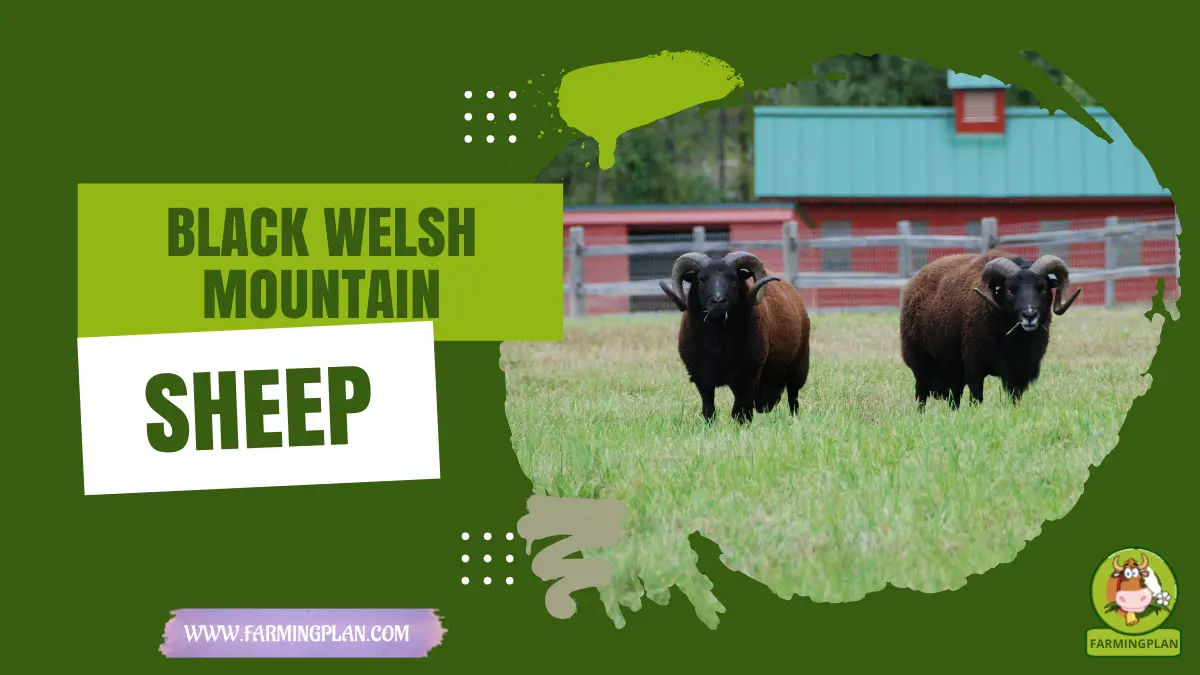
The Black Welsh Mountain sheep is a compact, alert, and sure-footed animal adapted to steep hillsides and rocky outcrops. The sheep displays a completely black fleece, black face, black ears, and solid dark hooves. In late summer, sun-exposed fleece tips may show a warm reddish-brown hue without losing structural fiber density.
Horns, Conformation & Fleece Traits
Sexual dimorphism is pronounced in head adornment. Rams carry strong, dark, backwards-curving spiral horns that clear the jaw line comfortably. Ewes are completely naturally polled (hornless) with clean, expressive faces. The tail is broad at the dock, tapering naturally toward the hocks.
The fleece is dense, short, and medium-grade with a staple length of 2.5 to 4.0 inches (6 to 10 cm). Testing averages between 30 and 36 microns with a Bradford count of 48s to 52s. Handspinners, knitters, and heritage tweed weavers seek this wool because it requires no synthetic chemical dyeing to maintain deep charcoal and ebony tones.
⚡ Black Welsh Mountain Sheep Performance & Production Matrix
| Performance Benchmark | Mountain Range Environment | Lowland Managed Pasture | Purebred Seedstock Flock |
|---|---|---|---|
| Birth Weight | 5.5 to 7.0 lbs (2.5 to 3.2 kg) | 6.5 to 8.5 lbs (2.9 to 3.9 kg) | 7.0 to 9.0 lbs (3.2 to 4.1 kg) |
| Weaning Weight (120 Days) | 45 to 55 lbs (20.4 to 24.9 kg) | 55 to 68 lbs (24.9 to 30.8 kg) | 60 to 75 lbs (27.2 to 34.0 kg) |
| Grease Fleece Weight | 3.5 to 4.5 lbs (1.6 to 2.0 kg) | 4.5 to 6.0 lbs (2.0 to 2.7 kg) | 5.0 to 6.5 lbs (2.3 to 2.9 kg) |
| Cold Carcass Dressing Yield | 48% to 50% finished weight | 50% to 52% finished weight | 51% to 53% prime yield |
| Ewe Lambing Rate | 115% to 130% single-dominant | 135% to 155% frequent twins | 140% to 160% high vigor |
Breed History, Heritage & North American Development
Historical records show black sheep grazing the Welsh mountains for over a millennium. Initially considered undesirable sports in commercial white flocks, Welsh farmers recognized that black wool felted into superior storm-resistant cloth for upland shepherds. By the late nineteenth century, aristocratic estates established dedicated black flocks for aesthetic ornamental parks. Matching forage or ration quality to life stage optimizes Black Welsh Mountain Sheep growth.
In 1920, Welsh breeders founded the Black Welsh Mountain Sheep Society in the United Kingdom to register purebred pedigrees and maintain rigorous breed purity. The first North American importation occurred in 1972 when sheep arrived in Maryland, establishing foundation lines now preserved under the American Black Welsh Mountain Sheep Association.
Because the North American population descended from a limited initial gene pool, registry officials maintain strict pedigree oversight to avoid inbreeding depression. Today, The Livestock Conservancy lists the breed as Threatened, making US breeding programs critical for global genetic conservation.
Housing, Shelter Dimensions & Winter Hardiness
Black Welsh Mountain sheep possess extraordinary hardiness. Their dense, weather-tight fleece and active metabolic adaptation allow them to tolerate heavy snowfall, driving rain, and sub-zero temperatures without physiological distress. They will graze through snow crusts that keep lowland sheep huddled near hay feeders.
Provide 14 to 18 square feet of dry shelter space per mature ewe in an open three-sided shed. Excellent ventilation is vital. Sheep generate considerable moisture through respiration, and trapped humidity inside warm barns triggers respiratory pneumonia far more rapidly than outdoor freezing breezes. Gradual dietary transitions protect digestive stability in Black Welsh Mountain Sheep.
Fencing must respect their mountain agility. Black Welsh sheep are athletic jumpers and can leap standard 36-inch field fencing if startled. Install 48-inch woven field wire with post spacing at 10 to 12 feet, reinforced with a hot top wire charged to 5,000 volts to deter coyotes and wandering canines.
Nutritional Requirements, Daily Rations & Feeding Protocols
These sheep are efficient foragers with modest nutritional overhead. They perform exceptionally well on mixed pasture, upland grasses, clover, blackberry brambles, and wild herbs. Overfeeding high-energy grain concentrates is detrimental, leading to excessive internal fat accumulation and difficult lambing presentations.
Dry ewes during maintenance require 2.0 to 2.5 pounds of average grass hay daily with 8% to 10% crude protein. In late gestation, increase forage quality to clean clover/grass mixes offering 12% crude protein, supplemented with 0.5 pounds of whole oats or barley per head per day. Review our complete pasture sheep nutritional requirements to balance dry matter intake across changing seasons. Selecting healthy foundation stock is the cornerstone of successful Black Welsh Mountain Sheep management.
Never allow sheep to access cattle or goat minerals containing high copper levels. Sheep store excess dietary copper in their livers until stress releases toxic quantities into the bloodstream, causing fatal hemolysis. Provide only specialized ovine minerals with copper levels strictly under 25 ppm.
Health Management, Common Diseases & Biosecurity Standards
Black Welsh Mountain sheep inherit hard, black hooves that resist foot rot and foot scald far better than soft-hoofed white breeds. Routine foot trimming twice annually keeps hoof walls level with the central sole pads. Run flocks through a 10% zinc sulfate footbath after wet periods to maintain hoof health.
Internal parasite management requires rotational pasture resting. While Black Welsh sheep demonstrate better parasite resilience than intensive lowland breeds, the barber pole worm (Haemonchus contortus) can still challenge growing lambs in warm, humid regions. Track eyelid mucous membranes with FAMACHA scoring and participate in the USDA APHIS Scrapie Eradication Program by maintaining official scrapie ear tags.
Administer the clostridial CD&T vaccine annually to all breeding animals 3 to 4 weeks before lambing begins. This timing ensures protective colostral antibodies are delivered to newborn lambs during their first 12 hours of life. Good predator-proofing and dry bedding safeguard Black Welsh Mountain Sheep comfort in harsh weather.
Breeding Management, Incubation & Brooding Offspring
Black Welsh Mountain ewes are seasonal short-day breeders. Estrus cycles initiate in late September and continue through January as daylight hours decrease. Gestation lasts between 144 and 150 days. Rams possess strong libido and can comfortably settle 35 to 40 ewes in a 45-day breeding season.
Ewes lamb with minimal human intervention. Their small, wedge-shaped heads and streamlined shoulders facilitate easy deliveries without dystocia. Maternal instincts are fierce, with mothers fiercely protecting newborn lambs against predators and bonding instantly in small claiming pens.
Shepherds comparing upland breeds frequently evaluate Black Welsh against the prick-eared Cheviot hill sheep production system. Both breeds offer upland resilience, but the Black Welsh provides the distinct market niche of naturally black fleece that commands specialty wool premiums.
US Ownership Budget & Annual Maintenance Costs
Registered breeding stock for this rare heritage breed commands premium investment. Breeding ewes typically range from $350 to $700, while registered rams with sound pedigree and horn clearance cost $500 to $1,200. Operating costs, however, remain among the lowest of any domesticated ovine breed. Monitoring water quality and mineral balance directly benefits Black Welsh Mountain Sheep vitality.
The table below summarizes expected annual maintenance expenses for a single mature Black Welsh Mountain ewe on managed pasture with winter hay supplementation in the United States.
⚡ Estimated Annual Budget & Maintenance Costs (USD)
| Expense Category | Budget Range (Low–High) | Operational Factors & Cost Inputs |
|---|---|---|
| Winter Hay & Roughage | $55 – $85 | 0.75 to 1.0 round bale of timothy/orchard grass hay per ewe per winter |
| Gestation Grain & Minerals | $25 – $45 | Late-gestation whole grain flush and ovine-safe copper-free mineral mix |
| Vaccines & Parasite Control | $15 – $25 | Annual CD&T vaccine, targeted anthelmintics, and zinc sulfate hoof soak |
| Annual Shearing & Wool Skirting | $12 – $20 | Professional shearing service fee and clean fleece bagging storage |
| Paddock Maintenance & Bedding | $10 – $20 | Straw bedding for lambing pens and perimeter electric charger power |
| Total Annual Operating Cost | $117 – $195 | Excludes initial capital purchase, stock trailer, and fencing costs |
🐑 Black Welsh Mountain Sheep Flock Forage & Pasture Calculator
Calculate winter hay bales, daily pasture forage intake, minerals, and water needs for your Black Welsh Mountain Sheep flock.
Frequently Asked Questions (FAQ)
What makes Black Welsh Mountain Sheep unique compared to other heritage breeds?
Black Welsh Mountain sheep are the only completely black breed of sheep native to the British Isles. Their wool maintains a rich black to reddish-black color without fading under intense sun exposure.
Do Black Welsh Mountain rams have horns?
Yes, mature rams develop large, curved spiral horns that sweep backwards from the head. Ewes are completely polled (naturally hornless) with clean black faces.
What is the micron count and quality of Black Welsh Mountain wool?
The wool measures between 30 and 36 microns with a staple length of 2.5 to 4 inches. It is medium-grade, durable, and sought after by handspinners for non-dyed tweed and outerwear.
How hardy are Black Welsh Mountain sheep in winter weather?
They are exceptionally hardy, bred to endure high-altitude Welsh winters with heavy rain and snow. Their dense fleece repels moisture, and they continue foraging through frozen pasture.
What is the flavor profile of Black Welsh Mountain lamb?
The meat offers a mild, sweet, aromatic flavor with very low exterior fat. It is lean and tender, making it a favorite for grass-fed lamb specialty butcher programs.
Are Black Welsh Mountain sheep prone to foot rot?
No, their hard, naturally pigmented black hooves are remarkably resistant to foot rot and foot scald compared to white-hoofed lowland breeds on damp ground.
Expert Verdict & Next Steps
The Black Welsh Mountain sheep delivers an ideal balance of visual distinction, rugged survival skills, and low-input productivity. For pasture managers aiming to maximize grass conversion while generating revenue from natural colored fiber and gourmet meat, this breed represents an outstanding long-term farm asset.
While shearing requires annual labor compared to hair breeds like the Katahdin commercial hair sheep, the artisanal value of natural black wool balances the equation. With disciplined flock biosecurity, rotational pasture grazing, and clean water access, Black Welsh Mountain sheep provide consistent returns across demanding North American environments. To evaluate alternative bloodlines and practical management routines, check our Brianzola Sheep overview.
📚Agricultural Reference & Scientific Citations
Standards and physiological data referenced in this guide comply with USDA APHIS Small Ruminant Health, The Livestock Conservancy, and the American Veterinary Medical Association (AVMA).


