

⚡ Bauscat Rabbit at a Glance: Key Specifications & Benchmarks
| Scientific Classification | Oryctolagus cuniculus (Large Commercial Albino Landrace) |
| Native Development Region | Nile Delta & Beheira Governorate, Egypt (1930s) |
| Mature Buck Body Weight | 8.5 to 10.0 lbs (3.8 to 4.5 kg) |
| Mature Doe Body Weight | 9.0 to 11.0 lbs (4.1 to 5.0 kg) |
| Fur Type & Coloration | Pure albino white; dense, lustrous rollback commercial fur |
| Average Litter Size | 7 to 9 kits per kindling; high kit nursing vigor |
| Market Slaughter Age | 11 to 12 weeks for 5.0-lb prime roasting fryer |
| Carcass Dressing Percentage | 60% to 64% with broad, plump meat loins |
The Bauscat rabbit (frequently referenced in zootechnical texts as the Egyptian Bouscat) is one of the most venerable and productive commercial meat rabbit breeds in North Africa and the Mediterranean basin. Developed in the fertile Nile Delta region during the 1930s by crossing imported French Bouscat Giant Blue (Géant Blanc du Bouscat) stock with native heat-adapted Baladi rabbits, this large-framed albino rabbit was bred to supply heavy roasting fryers in arid climates. Gradual dietary transitions protect digestive stability in Bauscat rabbit.
Commercial rabbit operations in warm regions often struggle with exotic European breeds that suffer acute appetite depression, reproductive sterility, and pneumonia when temperatures exceed 90°F. The Bauscat resolves these challenges by combining the colossal muscling and fast growth of French meat giants with the hardiness, high fertility, and solar heat tolerance of native Egyptian rabbits. Selecting healthy foundation stock is the cornerstone of successful Bauscat rabbit management.
With mature does frequently exceeding ten pounds, the Bauscat produces large litters of rapid-growing kits that convert simple grain-and-hay rations into lean, high-protein meat. Their docile disposition, outstanding mothering ability, and high carcass dressing yields have made them a preferred foundation breed for commercial cuniculiculture projects across the Middle East, Africa, and developing agricultural regions.
In addition, their dense, lustrous white pelts provide prime commercial fur that commands consistent value in specialty garment processing, maximizing total farmgate profits per cage. Good predator-proofing and dry bedding safeguard Bauscat rabbit comfort in harsh weather.
Breed Performance & Commercial Roaster Matrix
Evaluating the growth trajectories, feed conversion ratios, and slaughter yields of Bauscat rabbits allows commercial producers to structure profitable batch production cycles.
📊 Production & Meat Yield Performance Matrix
| Performance Metric | Bauscat Breed Benchmark | Commercial Production Significance |
|---|---|---|
| Average Birth Weight | 2.0 to 2.4 oz (58 to 68 grams) | Large, robust kits with high early survival rates |
| Weaning Weight (35 Days) | 1.6 to 2.2 lbs (725 to 1,000 grams) | Heavier weaning mass accelerates post-weaning fryer finishing |
| Average Daily Gain (ADG) | 32 to 38 grams/day (post-weaning) | Rapid muscle deposition without excessive visceral fat trim |
| Carcass Dressing Percentage | 60% to 64% | Exceptional yield of broad loins, shoulders, and hindquarters |
| Feed Conversion Efficiency | 3.1:1 to 3.5:1 | Efficient conversion of agricultural byproducts and standard pellets |
These performance benchmarks illustrate why the Bauscat is favored for heavy fryer and roaster production. Kits grow rapidly on maternal milk, weaning easily onto solid rations without the post-weaning digestive crashes common in lighter, more fragile breeds. Monitoring water quality and mineral balance directly benefits Bauscat rabbit vitality.
At 11 to 12 weeks of age, fryers achieve liveweights of 4.8 to 5.5 pounds, dressing out to clean, plump carcasses weighing over 3.0 pounds. The meat is tender, fine-fibered, and pure white, with high moisture retention that excels in roasting and commercial processing.
Does maintain high reproductive longevity, routinely kindling six to seven litters over two productive years without losing skeletal condition or maternal milk volume. Practical hands-on husbandry ensures consistent results when raising Bauscat rabbit.
Historical Lineage & Nile Delta Breeding History
The Bauscat rabbit was created in 1932 by Egyptian agricultural breeder Dr. Amin Zaher in the Beheira governorate of the lower Nile Delta. Dr. Zaher imported French Bouscat Giant Blue rabbits, which were celebrated in Europe for colossal size and luxurious white fur but lacked the heat tolerance necessary to survive in Egypt’s arid climate.
Through systematic crossbreeding with native Egyptian Baladi rabbits and rigorous selection under natural farm temperatures, Dr. Zaher and subsequent researchers at Cairo University stabilized a true-breeding albino line. Explore related commercial breeds in our rabbit farming guide. Early intervention at the first sign of lethargy protects overall Bauscat rabbit flock or herd health.
The new breed demonstrated 25% higher growth rates than native Baladi stock while retaining 100% of the landrace’s resistance to local respiratory and digestive pathogens. By the 1960s, the Bauscat had become the standard meat breed distributed by the Egyptian Ministry of Agriculture to rural farmers and state commercial rabbitries.
Today, purebred Bauscat foundation lines are preserved at agricultural universities across Egypt, continuing to serve as valuable genetic material for subtropical meat rabbit improvement. Structured culling and biosecurity protocols strengthen Bauscat rabbit genetic quality.
Physical Conformation & Skeletal Architecture
The Bauscat is a large, stately rabbit possessing a semi-mandolin to commercial body conformation. The body is long, deep, and broad, with well-arched loins and heavily muscled hindquarters. The chest is broad and prominent, housing expansive lung capacity that supports efficient respiration during hot weather.
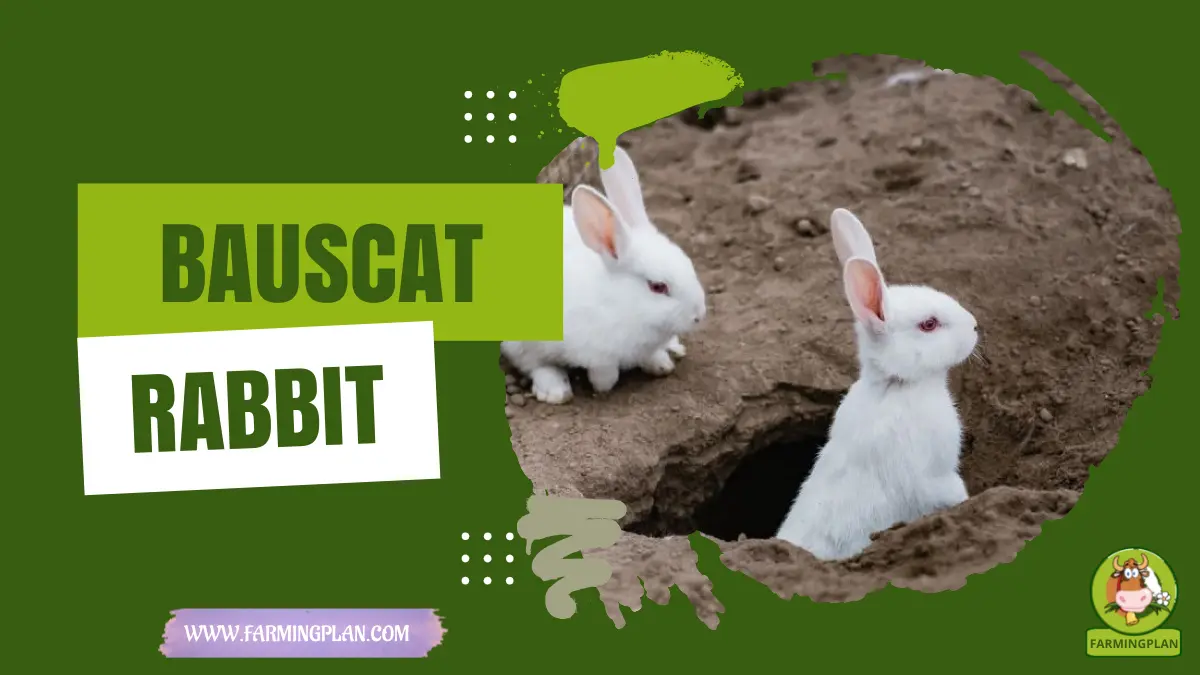
The head is large, broad in bucks and more refined in does, carried on a short, strong neck. The eyes are bright pink or pale ruby, with alert, responsive expression. The ears are long, erect, and firmly attached, measuring 5.0 to 5.8 inches in length with rounded tips, serving as effective heat radiators. Maintaining clean feeders and sanitized equipment supports sustainable Bauscat rabbit care.
The fur is pure albino white, classified as commercial rollback. It is dense, lustrous, and remarkably soft, measuring approximately 1.0 to 1.25 inches in length. When stroked backward, the fur rolls smoothly back into position without flying wildly.
The legs are straight, strong-boned, and well-proportioned, terminating in heavily furred footpads that protect against wire cage abrasion. Does carry a neat, well-balanced dewlap that develops with sexual maturity. Consistent daily observation helps keepers spot early changes in Bauscat rabbit health and behavior.
Nutritional Strategies & Commercial Feeding Programs
Because of its larger frame and fast growth rate, the Bauscat requires a well-structured nutritional program. Providing balanced, fiber-dense rations prevents digestive disturbances and supports high lactation yields.
Feed a commercial pelleted ration containing 16% to 18% crude protein, 14% to 17% crude fiber, and 2.5% to 3.5% fat. Growing fryers and lactating does should receive free-choice pellets alongside unlimited fresh timothy or berseem (Egyptian clover) hay. Review general livestock nutrition standards in our livestock feeding guide. Clean housing, fresh water, and balanced nutrition remain essential for Bauscat rabbit productivity.
Restricted feeding (4.5 to 5.5 ounces of pellets daily) is recommended for dry does and resting bucks to prevent excessive visceral fat deposition, which can impair breeding fertility and cause kindling complications.
Water requirements are substantial for this large breed. A mature lactating doe with eight kits can consume over 1.2 gallons of water daily during warm weather. Automatic nipple drinkers connected to a reliable, clean water supply must be checked daily to ensure unrestricted flow. Tracking feed intake and body condition supports long-term Bauscat rabbit performance.
Hutch Architecture & Large-Breed Cage Specifications
Due to its mature weight of 9 to 11 pounds, the Bauscat requires larger cage dimensions than standard commercial breeds. Confining large does in cramped cages leads to sore hocks, poor kit care, and reduced breeding longevity. Following biosecurity best practices reduces disease risk in any Bauscat rabbit operation.
Individual doe cages should measure at least 36 inches wide by 30 to 36 inches deep and 18 to 20 inches high, constructed from heavy-gauge galvanized welded wire mesh. Flooring must be fabricated from 14-gauge 1×0.5-inch wire mesh, fitted with a plastic or wooden resting board (at least 10×15 inches) to allow the rabbit to rest its hind hocks off the wire.
Large nest boxes measuring 14 inches wide by 20 inches long and 10 inches high provide adequate room for the doe to kindle and nurse without trampling newborn kits. Clean wood shavings and soft straw should be provided for nesting material. Seasonal adjustments to shelter and diet keep Bauscat rabbit thriving year-round.
Barn ventilation must be continuous and draft-free, utilizing ridge vents and circulating fans to keep ammonia levels below 10 ppm and relative humidity between 55% and 70%.
Maternal Instincts & Kid Kindling Management
Bauscat does are renowned for outstanding maternal performance and calm, reliable kindling behavior. They exhibit strong nesting instincts, pulling copious quantities of soft chest fur to build warm, protective nests several days before kindling. Proper record-keeping makes breeding and culling decisions easier for Bauscat rabbit keepers.
Litters average 7 to 9 large, vigorous kits. Does produce abundant, rich milk that allows kits to achieve rapid daily weight gains. Kindling problems are rare due to the doe’s roomy pelvic structure, with most deliveries occurring smoothly during quiet nighttime hours.
Does are gentle and cooperative with caretakers, allowing daily nest box inspections and kit handling without displaying aggressive scratching or box-stomping behavior. Providing adequate space and ventilation prevents common stress issues in Bauscat rabbit.
Bucks possess a steady, calm disposition. They learn breeding routines quickly and remain manageable for farm staff throughout their working lives. If you are balancing utility output and herd resilience, take a look at our Chaudry Rabbit reference guide.
Veterinary Protocols & Cunicular Health Maintenance
Maintaining optimal herd health in a Bauscat rabbitry requires disciplined preventive management. The primary disease risks in commercial cuniculiculture include respiratory pasteurellosis, hepatic and intestinal coccidiosis, and viral hemorrhagic disease. Understanding breed-specific traits helps maximize Bauscat rabbit longevity and output.
Ensure superior barn air exchange to eliminate ammonia gas, which paralyzes the ciliated epithelial cells of the respiratory tract and opens the door for Pasteurella multocida infections. Sanitize cage wire and feeders monthly using an approved quaternary ammonium or iodine disinfectant. Compare animal health strategies in our veterinary disease prevention guide.
Coccidiosis is controlled through rigid hutch hygiene and keeping waterers free of fecal dust. Regular veterinary monitoring using fecal flotation identifies subclinical parasite shedding before clinical diarrhea occurs. Routine preventive care saves time and lowers veterinary costs for Bauscat rabbit.
Vaccination against Rabbit Hemorrhagic Disease Virus (RHDV-2) is strongly recommended for all breeding stock, administering annual boosters to ensure continuous herd immunity.
Commercial Breeding Calendars & AI Integration
Commercial rabbitries managing Bauscat rabbits utilize structured breeding cycles to maintain steady year-round meat production. Does reach breeding weight at 5.5 to 6.5 months of age, while young bucks enter service at 6 to 7 months. Matching forage or ration quality to life stage optimizes Bauscat rabbit growth.
In semi-intensive commercial setups, does are re-mated 14 to 21 days after kindling, achieving 5 to 6 litters per year. Weaning occurs at 35 days, allowing the doe a 10-day rest period before her next delivery. Weaned fryers are housed in group finishing pens of 4 to 6 animals until reaching slaughter weight.
Artificial insemination (AI) programs using fresh diluted semen from top-performing performance-tested sires allow synchronization of hundreds of does on a single day, maximizing labor efficiency during kindling and marketing. Gradual dietary transitions protect digestive stability in Bauscat rabbit.
Careful performance recording tracks litter size at birth, 35-day weaning weight, and 70-day feed conversion ratio, ensuring that breeding stock selection continuously elevates herd productivity.
Interactive Commercial Rabbit Feed & Fryer Yield Calculator
Calculate your rabbitry’s daily pelleted feed requirements, projected monthly fryer meat output, and annual commercial revenues using our interactive cuniculiculture calculator below. Selecting healthy foundation stock is the cornerstone of successful Bauscat rabbit management.
🐇 Bauscat Rabbit Daily Hay & Pellet Calculator
Calculate daily Timothy hay (unlimited bulk), pellet rations, fresh greens, and clean water intake for your Bauscat Rabbit.
Frequently Asked Questions: Bauscat Rabbit Care
What is the Bauscat rabbit and what was its breeding origin?
The Bauscat rabbit (also known as the Egyptian Bouscat) is a commercial albino meat and fur breed developed in Egypt during the 1930s by crossing French Bouscat Giant Blue stock with native Baladi rabbits and New Zealand Whites.
How heavy do mature Bauscat rabbits get?
Mature Bauscat bucks typically weigh 8.5 to 10.0 pounds (3.8 to 4.5 kg), while mature does weigh 9.0 to 11.0 pounds (4.0 to 5.0 kg), placing them in the large-framed commercial fryer class.
What are the defining physical characteristics of the Bauscat?
The breed features a long, deep muscular body, pure albino white fur, pink eyes, long upright ears, and dense bone structure capable of carrying heavy meat fleshing.
How does the Bauscat rabbit perform under high temperatures?
Having undergone nearly a century of continuous selection in the Nile Delta, the Bauscat exhibits remarkable tolerance to heat stress, maintaining fertility and lactation in subtropical climates.
What is the commercial meat yield of Bauscat fryers?
Bauscat fryers achieve rapid growth, reaching 4.8 to 5.5 pounds (2.2 to 2.5 kg) by 11 to 12 weeks of age, yielding carcass dressing percentages between 60% and 64% with succulent, tender white meat.
Commercial Viability & Heavy Fryer Economics
The economic profitability of Bauscat rabbit farming is driven by their heavy market weight and high meat-to-bone ratio. While lighter commercial breeds produce 4.0-pound fryers, the Bauscat routinely delivers 5.0 to 5.5-pound roasters that yield heavy, thick-cut meat portions commanding premium wholesale prices.
Additionally, their large white pelts provide prime commercial raw material for garment and fur processing, delivering valuable secondary revenue per finished animal. When managed in well-ventilated, low-stress facilities, a Bauscat enterprise offers exceptional capital returns for commercial livestock entrepreneurs. Compare commercial meat rabbit performance in our American rabbit breed guide. Good predator-proofing and dry bedding safeguard Bauscat rabbit comfort in harsh weather.
Smallholder farms and commercial rabbitries operating in subtropical or Mediterranean environments find that the Bauscat provides unmatched reliability, rapid growth, and meat quality, cementing its status as an elite commercial meat producer.
📚Agricultural Reference & Scientific Citations
Standards and physiological data referenced in this guide comply with American Rabbit Breeders Association (ARBA), USDA APHIS Animal Health, and the FAO Domestic Animal Diversity Information System.


