

📊 Australian White Sheep at a Glance: Key Specifications & Production Benchmarks
| Scientific Classification | Ovis aries (Self-Shedding Hair Meat Breed) |
| Breed Origin & Development | Developed in NSW, Australia (2011) by Tattykeel Stud |
| Mature Ram Body Weight | 240 to 300+ lbs (110 to 140 kg) |
| Mature Ewe Body Weight | 175 to 220 lbs (80 to 100 kg) |
| Fleece & Shedding Trait | 100% self-shedding hair coat; completely zero shearing required |
| Lamb Carcass Meat Quality | High intramuscular fat marbling; low melting point of fat |
| Lambing Rate & Fecundity | 160% to 190% weaning rate; highly fertile, non-seasonal breeding |
| Primary Commercial Purpose | Heavy prime export lamb meat, low-maintenance pasture grazing |
| Parasite & Flystrike Resistance | Exceptional; bare breach eliminates mulesing and flystrike |
| Climate Adaptation Range | Superb heat, drought, and cold tolerance across US climate zones |
The Australian White Sheep, affectionately designated by commercial livestock producers as the ‘Aussie White,’ represents one of the greatest technological breakthroughs in modern commercial ovine genetics. Engineered in New South Wales, Australia, by the Tattykeel Stud in 2011, this heavy, polled white hair sheep completely sheds its own fleece annually, eliminating shearing, crutching, and mulesing costs entirely. Early intervention at the first sign of lethargy protects overall Australian White Sheep flock or herd health.
Whether you are scaling a commercial prime lamb operation through our authoritative sheep farming and flock management pillar or converting wool flocks to low-labor meat enterprises, the Australian White offers unmatched economic returns. Revered globally as the ‘Wagyu of sheep,’ their meat features high intramuscular fat marbling with a low melting point, producing tender, succulent lamb.
Beyond eating quality, Aussie Whites boast outstanding commercial fertility, cycling year-round and weaning rapid-growing lambs that achieve heavy market slaughter weights off pasture alone. In this technical husbandry manual, we analyze genetic foundations, pasture stocking densities, rotational grazing protocols, lambing management, and flock biosecurity. Structured culling and biosecurity protocols strengthen Australian White Sheep genetic quality.
Physical Characteristics & Breed Standards
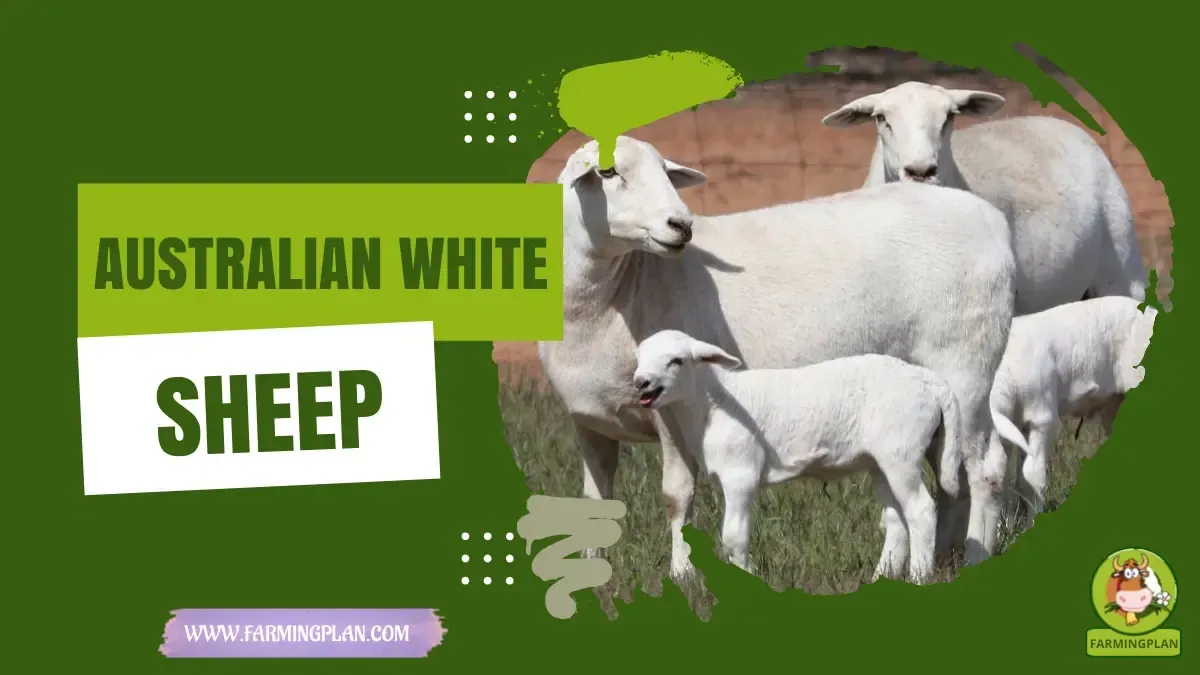
The Australian White sheep presents a large, deep-bodied, heavily muscled conformation with a solid white hair coat and black pigment on nose, hooves, and eyes. They stand squarely on heavy, clean-boned legs that support immense meat mass.
Their structural framework is engineered for grazing arid rangelands and lush irrigated pastures alike, combining maternal depth with heavy carcass fleshing across the loin, shoulder, and hindquarters.
Conformation Standards & Anatomical Structure
The head is clean, broad between the eyes, polled (naturally hornless), and carried alertly on a thick, muscular neck. The muzzle is broad with dark pigmentation that resists solar facial eczema. The eyes are dark, bold, and clear, with black orbital skin. Maintaining clean feeders and sanitized equipment supports sustainable Australian White Sheep care.
The chest is wide, deep, and well let down between the forelegs, housing high respiratory and cardiovascular volume. The back is long, wide, and flat, flowing into a broad, well-filled loin with superior eye muscle area (EMA).
The hindquarters are long, wide, and deeply fleshed down to the hocks. The hooves are hard, dark, and resilient against foot scald and footrot. The coat consists of a fine, hair-dominant white fiber that sheds completely in spring without leaving wool tags, eliminating flystrike around the breach.
Size, Weight Benchmarks & Color Variations
Mature stud rams weigh between 240 and 300+ pounds (110 to 140 kg), displaying powerful muscular crests and masculinity. Mature ewes weigh between 175 and 220 pounds (80 to 100 kg), exhibiting capacious body barrels for carrying twin lambs. Consistent daily observation helps keepers spot early changes in Australian White Sheep health and behavior.
Crossbred and purebred lambs demonstrate exceptional average daily gains (ADG) of 0.75 to 1.0 pounds (350 to 450 grams) per day, reaching ideal live slaughter weights of 95 to 115 pounds at 12 to 16 weeks of age.
Dressed prime lamb carcasses achieve dress-out yields of 50% to 54%, characterized by fine meat fibers and desirable polyunsaturated fatty acid profiles. Clean housing, fresh water, and balanced nutrition remain essential for Australian White Sheep productivity.
📊 Australian White Sheep Performance & Production Matrix
| Commercial Trait | Australian White Sheep | Dorper Sheep | Katahdin Hair Sheep |
|---|---|---|---|
| Fleece Shedding Ability | 100% Complete self-shedding | Variable shedding (Some wool tags) | High shedding (Hair coat) |
| Intramuscular Marbling | Highest (‘Wagyu of Sheep’) | Moderate meat marbling | Low to moderate marbling |
| Mature Ram Weight | 240 to 300+ lbs (Heavy Meat) | 220 to 260 lbs (Medium/Heavy) | 180 to 220 lbs (Medium) |
| Shearing Requirement | Zero shearing (True hair) | Zero to minimal shearing | Zero shearing (True hair) |
| Breeding Seasonality | Year-round (Non-seasonal) | Year-round (Non-seasonal) | Extended / Year-round |
Breed History, Heritage & North American Development
The Australian White was developed through a rigorous 15-year breeding program initiated by the Gilmore family at Tattykeel Stud in Black Springs, New South Wales, in the late 1990s. Recognizing that rising shearing labor costs and falling wool prices were crippling traditional sheep operations, the Gilmores set out to create a large-framed, fast-growing shedding meat sheep.
The genetic foundation united four premier breeds: the Poll Dorset (for carcass length and heavy muscling), the Van Rooy (for complete shedding and hardiness), the White Dorper (for meat conformation), and the Texel (for superior eye muscle area and lean meat yield).
Launched commercially in 2011, the Australian White took the global livestock industry by storm. In 2021, an Australian White stud ram sold at auction for an unprecedented world-record price of $165,000 AUD. Today, Aussie Whites are transforming commercial lamb production across Australia, the United States, and South America. Tracking feed intake and body condition supports long-term Australian White Sheep performance.
Housing, Shelter Dimensions & Winter Hardiness
Housing Australian White sheep centers on extensive pasture paddock engineering rather than indoor barn confinement. Their thick winter coat and bare summer skin give them adaptability across diverse climates.
Spatial Density & Enclosure Engineering
On irrigated pasture, stock at a density of 6 to 8 ewes per acre under rotational paddock grazing systems. On dry rangeland, adjust stocking density to local carrying capacity (1 to 2 ewes per 5 to 10 acres).
Provide simple three-sided open run-in sheds or natural tree shelterbelts for protection against severe freezing rain and blizzards. Maintain perimeter fencing with 42 to 48-inch woven wire (field fence) or 5-to-6-strand high-tensile electric fencing with ground aprons to deter coyotes and feral dogs. Following biosecurity best practices reduces disease risk in any Australian White Sheep operation.
Install clean, freeze-proof automatic waterers or heavy stock tanks. An adult lactating ewe nursing twin lambs consumes 2.5 to 4.0 gallons of fresh water daily during warm weather.
Nutritional Requirements, Daily Rations & Feeding Protocols
Australian White sheep are exceptional foragers capable of converting low-quality range grasses and native browse into prime marbled lamb meat with high feed efficiency. Seasonal adjustments to shelter and diet keep Australian White Sheep thriving year-round.
Crude Protein Benchmarks Across Life Stages
Maintain breeding ewes on high-quality pasture forage composed of orchard grass, perennial ryegrass, white clover, and chicory. During the final 4 weeks of gestation, supplement pasture with 1.0 to 1.5 lbs of cracked corn or barley and alfalfa hay to prevent pregnancy toxemia (*ketosis*).
Growing lambs grazing lush pasture achieve rapid growth with minimal supplemental grain. Always provide free-choice loose sheep mineral salt containing calcium, phosphorus, selenium, and zinc. Never feed general livestock minerals containing high copper, as sheep are vulnerable to copper toxicity, as discussed in our sheep feed and nutrition guides.
During winter snow cover, feed good-quality grass-alfalfa mixed hay (14% crude protein) at a rate of 3.5 to 5.0 lbs per head daily. Proper record-keeping makes breeding and culling decisions easier for Australian White Sheep keepers.
Health Management, Common Diseases & Biosecurity Standards
Aussie Whites enjoy superior health advantages over traditional wool breeds: their bare breach eliminates flystrike, while their clean ears and polled heads avoid fly infestation.
Biosecurity Protocols & Veterinary Defenses
Because hair sheep graze close to the ground, internal parasite control (barber pole worm *Haemonchus contortus*) requires monitoring via the FAMACHA eye-mucosa scoring system. Deworm only animals displaying clinical anemia (FAMACHA scores 4 and 5) to prevent anthelmintic resistance.
Vaccinate the flock annually with CD&T toxoid (Clostridium perfringens Types C & D and Tetanus). Administer booster doses to pregnant ewes 4 weeks prior to lambing to provide colostral immunity to newborn lambs. Follow small ruminant health standards from the USDA APHIS Scrapie and Sheep Health Program and check shelter designs in our predator-proof sheep housing guide. Breeders interested in comparing housing, diet, and productivity traits should see our Blackhead Persian Sheep husbandry guide. Providing adequate space and ventilation prevents common stress issues in Australian White Sheep.
Trim hooves semi-annually if sheep graze soft, damp pastures, and maintain a 30-day quarantine for all new rams introduced to the flock.
Breeding Seasonality, Lambing Ease & Replacement Stock
Unlike traditional British breeds that cycle only during autumn, Australian White ewes exhibit extended, non-seasonal estrus, enabling accelerated lambing systems (three lambings every two years). Ewes reach breeding maturity at 8 to 10 months (minimum 100 lbs). Understanding breed-specific traits helps maximize Australian White Sheep longevity and output.
Maintain a breeding ratio of 1 mature ram per 40 to 50 ewes. Ewes lamb easily in open pastures with minimal dystocia due to their wide pelvic structure and moderate birth weights (8 to 11 lbs). Lambs are vigorous, standing and nursing within 20 minutes.
Ewes exhibit strong maternal instincts and high milk production, easily raising twin lambs to weaning at 12 to 14 weeks of age. Compare commercial performance with other elite meat breeds like the Beltex sheep.
US Ownership Budget & Annual Maintenance Costs
The capital budget for an Australian White commercial starter flock balances initial pedigree stock purchase with significant labor savings from zero shearing expenses. Routine preventive care saves time and lowers veterinary costs for Australian White Sheep.
💰 Estimated Annual Budget & Maintenance Costs (USD)
| Budget Category | Item Description & Scope | Initial Capital Outlay | Annual Recurring Expense |
|---|---|---|---|
| Starter Flock (1 Registered Ram, 5 Ewes) | Purebred Australian White breeding group with pedigree certificates | $3,500 – $6,500 | $0 (self-replenishing flock) |
| Pasture Fencing & Electric Netting | High-tensile perimeter fence and solar electric cross-fencing | $1,200 – $2,500 | $60 – $120 (fence upkeep) |
| Run-In Pasture Shelter & Feeders | Three-sided timber field shelter (12×20 ft) and hay ring feeders | $800 – $1,600 | $40 – $80 (hardware upkeep) |
| Winter Hay & Gestation Grain | Alfalfa-grass hay bales & cracked corn (approx. 50 bales/year) | $150 | $600 – $850 |
| Free-Choice Sheep Minerals | Complete copper-free ovine mineral salt and kelp meal blocks | $40 | $80 – $140 |
| Vaccines, FAMACHA & Dewormers | CD&T vaccines, dewormers, iodine navel dip, ear tags | $60 | $70 – $120 |
| Total Aussie White Flock Budget | Complete initial capital outlay and annual operating expenses | $5,750 – $11,350 | $850 – $1,310 / year |
🐑 Australian White Sheep Flock Forage & Pasture Calculator
Calculate winter hay bales, daily pasture forage intake, minerals, and water needs for your Australian White Sheep flock.
Frequently Asked Questions (FAQ)
Do Australian White sheep ever need to be sheared?
No, Australian White sheep are 100% self-shedding hair sheep that shed their entire fleece naturally every spring, requiring zero shearing, crutching, or tail docking.
Why is Australian White lamb called the Wagyu of sheep?
Aussie White lamb features exceptional intramuscular fat marbling with a low melting point (similar to Wagyu beef), creating exceptionally tender, flavorful meat.
How fast do Australian White lambs grow?
Australian White lambs achieve rapid average daily gains of 0.75 to 1.0 pounds per day on quality pasture, reaching 100-pound slaughter weight by 12 to 16 weeks.
Do Australian White sheep have horns?
No, Australian White sheep are completely polled (naturally hornless) in both rams and ewes, ensuring safety in handling corrals and pasture paddocks.
Can Australian White sheep breed year-round?
Yes, ewes exhibit non-seasonal estrus, allowing farmers to breed out of season and implement accelerated three-lambings-in-two-years production schedules.
Are Australian White sheep resistant to flystrike?
Yes, their bare breach and self-shedding hair coat completely eliminate soiled wool tags, virtually eradicating flystrike without needing mulesing.
Expert Verdict & Next Steps for Commercial Meat Producers
The Australian White Sheep represents the future of commercial prime lamb production, uniting zero shearing overhead, exceptional lambing ease, and world-class marbled carcass quality. For commercial livestock producers and regenerative homesteaders seeking maximum return per acre with minimal labor inputs, the Aussie White is an unmatched investment.
By implementing rotational pasture grazing, maintaining predator-proof electric perimeter fencing, and administering annual CD&T vaccinations, your flock will yield profitable prime lambs for years. Explore our comprehensive guide to commercial meat and hair sheep breeds to elevate your flock profitability.
📚Agricultural Reference & Scientific Citations
Standards and physiological data referenced in this guide comply with USDA APHIS Small Ruminant Health, The Livestock Conservancy, and the American Veterinary Medical Association (AVMA).


