

⚡ Czech Spot Rabbit at a Glance: Key Specifications & Benchmarks
| Scientific Name | Oryctolagus cuniculus domesticus (Spotted Papillon Subtype) |
| Czech Breed Name | Český strakáč (Czech Pied / Spotted Rabbit) |
| Breed Origin | Bohemia (Prague and Central Bohemian Region), Czech Republic |
| Average Mature Weight | 7.3 to 8.8 lbs (3.3 to 4.0 kg) |
| Primary Purpose | Dual-purpose meat production, exhibition fancy, heritage preservation |
| Signature Marking Trait | Distinctive ‘butterfly’ nose patch, eye rings, cheek spots, and dorsal eel-stripe |
| Average Litter Size | 6 to 8 active, vigorous kits per kindle |
| Enclosure Requirement | Minimum 30×36 inches with resting board and proper ventilation |
The Czech Spot rabbit, known throughout Central Europe by its native name Český strakáč, is one of the oldest, most visually striking, and culturally beloved heritage cuniculture breeds of the Czech Republic. Originating in Bohemia in the late nineteenth century, this medium-sized spotted rabbit was bred by smallholders who combined traditional checkering genetics with hardy domestic farm stock. Their goal was a vigorous, self-reliant utility animal that provided tender farm meat while sporting a festive, symmetrical coat pattern. Understanding breed-specific traits helps maximize Czech Spot Rabbit longevity and output.
Homesteaders exploring our rabbit farming and cuniculture care guides will appreciate the Czech Spot’s remarkable thriftiness and vigorous constitution. While delicate exhibition breeds often suffer from digestive sensitivity, the Czech Spot maintains robust gastrointestinal vitality on simple rations of grass hay, garden forage, and modest pellets. Routine preventive care saves time and lowers veterinary costs for Czech Spot Rabbit.
The breed is instantly recognizable by its classic English-spotted papillon markings: a sharply defined ‘butterfly’ patch across the nose, dark eye circles, isolated cheek spots, and an unbroken dorsal ‘eel-stripe’ flanked by symmetrical side spots. Achieving balanced markings presents an engaging challenge for heritage exhibition breeders.
Their lively yet manageable temperament, excellent mothering skills, and rapid fryer growth make them an outstanding candidate for family meat production and youth 4-H projects alike. Matching forage or ration quality to life stage optimizes Czech Spot Rabbit growth.
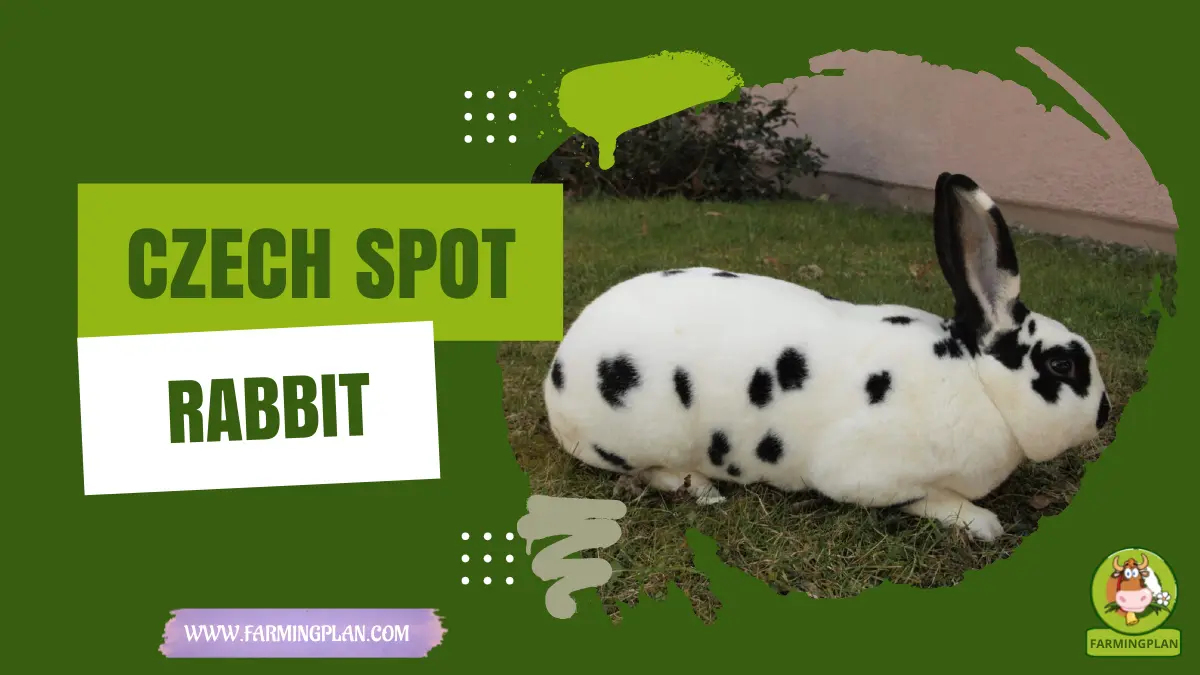
Physical Characteristics & Breed Standards
The Czech Spot displays a well-balanced, cylindrical, and muscular commercial body conformation that emphasizes functional meat production. The back rises gently from the shoulders to a rounded, plump rump, supported by straight, athletic limbs.
The head is medium-large and expressive, particularly wide in mature breeding bucks, with bright, alert dark eyes that match coat spotting. The ears are erect, well-furred, and measure 4.1 to 4.5 inches (10.5 to 11.5 cm) in length, carried in a clean V-shape. Gradual dietary transitions protect digestive stability in Czech Spot Rabbit.
Conformation Standards & Anatomical Structure
The shoulders are well-fleshed and set flush against the ribs, leading into a broad chest floor. The loin is wide and thick, while the hindquarters carry substantial meat down over the thighs toward the hocks.
The fur is rollback type, dense, soft, and glossy, with a uniform length of about one inch. When brushed backward, it snaps smoothly back into position, displaying a sparkling pure white ground color that provides sharp contrast for colored markings. Selecting healthy foundation stock is the cornerstone of successful Czech Spot Rabbit management.
Size, Weight Benchmarks & Color Variations
Mature Czech Spot bucks weigh between 7.3 and 8.4 lbs (3.3 to 3.8 kg), while mature does average 7.7 to 8.8 lbs (3.5 to 4.0 kg). Does possess a slightly longer frame and wide pelvis that facilitates unassisted kindling.
Color variants for markings are diverse: black (černý), blue (modrý), havana brown, madagascar (tortoiseshell), tricolor (black and yellow on white), and yellow. All colored spots must be sharply delineated from the snow-white background without stray colored hairs. Good predator-proofing and dry bedding safeguard Czech Spot Rabbit comfort in harsh weather.
⚡ Czech Spot Rabbit Performance & Production Matrix
| Breed Conformation Trait | Czech Spot Standard Metric | English Spot Comparison | Homestead Benefit |
|---|---|---|---|
| Mature Body Mass | 7.3 – 8.8 lbs | 5.0 – 6.0 lbs | Substantially heavier fryer meat yield per butchered rabbit |
| Marking Pattern | Butterfly nose, spine stripe, side spots | Chain spotting pattern | Distinctive heritage exhibition appearance |
| Mothering Ability | Exceptional milk & nest building | Moderate | High kit survival with minimal breeder intervention |
| Forage Efficiency | High conversion on rough hay | Requires concentrated feed | Economical feed conversion on farm-grown forage |
| Temperament Score | Alert, curious, docile | High-energy / jumpy | Easy and safe handling for family smallholders |
Breed History, Heritage & North American Development
The historical development of the Český strakáč began in Bohemia around 1880, where smallholders crossed local spotted landrace rabbits with imported French Papillons and English Spots. Breeders wanted a rabbit larger than the petite English Spot, yet hardier and easier to kindle than giant checkered breeds.
By 1910, Czech cuniculture pioneer Václav Patočka and fellow fanciers codified the first unified breed standard, selecting strictly for balanced side spots, a solid dorsal stripe, and high meat conversion. The breed quickly spread across village rabbitries in Central Bohemia. Monitoring water quality and mineral balance directly benefits Czech Spot Rabbit vitality.
During the twentieth century, the Czech Association of Small Livestock Breeders (ČSCH) maintained specialized breed clubs, organizing national competitions in Prague that established the Czech Spot as a national cultural emblem.
In recent years, European preservation groups have championed the breed, introducing pure breeding trios to international breeders seeking resilient heritage meat rabbits with classic exhibition charm. Practical hands-on husbandry ensures consistent results when raising Czech Spot Rabbit.
Housing, Shelter Dimensions & Winter Hardiness
Housing Czech Spot rabbits demands dry, clean, and draft-free hutches engineered to protect animals from seasonal temperature extremes. Like all domestic rabbits, they tolerate cold winter weather far better than summer heat.
Provide all-wire or timber-frame hutches offering at least 30×36 inches (7.5 square feet) of floor space per breeding doe, with a vertical height of 18 inches. The floor should consist of heavy-gauge 14-gauge galvanized wire mesh (1/2×1 inch) that permits droppings to pass through cleanly into collection trays below. Early intervention at the first sign of lethargy protects overall Czech Spot Rabbit flock or herd health.
Spatial Density & Enclosure Engineering
Always install a smooth plastic or wooden resting board (10×14 inches) over a portion of the wire floor to prevent sore hocks (pododermatitis) and provide comfortable resting posture. Equip hutches with clean wooden or metal nest boxes (12×18 inches) packed with fresh straw for kindling.
Ensure the rabbitry has excellent ventilation along the roof ridge to eliminate rising ammonia fumes. In hot summer weather, provide frozen water bottles and evaporative air coolers to keep temperatures below 82°F (28°C). Structured culling and biosecurity protocols strengthen Czech Spot Rabbit genetic quality.
Nutritional Requirements, Daily Rations & Feeding Protocols
The digestive health of the Czech Spot rabbit relies strictly on high-fiber fermentation in the hindgut. Diets low in fiber cause cecal stasis, gut hypomotility, and fatal digestive dysbiosis. Maintaining clean feeders and sanitized equipment supports sustainable Czech Spot Rabbit care.
Comparing feeding practices with our Californian meat rabbit care guide shows how quality roughage maintains gut flora. Clean, sun-cured timothy, brome, or orchardgrass hay must be accessible 24 hours a day.
Crude Protein Benchmarks Across Life Stages
Adult dry rabbits maintain optimal weight on free-choice grass hay plus a measured daily serving of commercial 16% crude protein (CP) rabbit pellets (approx. 1/3 cup per day). Pellets should provide at least 18% to 22% crude fiber. Consistent daily observation helps keepers spot early changes in Czech Spot Rabbit health and behavior.
Pregnant and nursing does require free-choice 18% CP alfalfa-based pellets and clean clover hay to support milk production. Provide daily fresh leafy greens (such as dandelion greens, romaine lettuce, and parsley) introduced slowly to adult rabbits.
Continuous access to clean, fresh water is mandatory. Provide water in stainless-steel valve water bottles or heavy earthenware crocks cleaned daily. A nursing doe and her litter consume up to a gallon of water per day. Clean housing, fresh water, and balanced nutrition remain essential for Czech Spot Rabbit productivity.
Health Management, Common Diseases & Biosecurity Standards
Czech Spot rabbits are vigorous and disease-resistant when housed in clean, well-ventilated environments. However, domestic cuniculture requires strict vigilance against common pathogens like Pasteurella multocida (snuffles) and rabbit hemorrhagic disease (RHDV2).
Rabbitry owners should follow biosecurity standards established by the USDA Animal and Plant Health Inspection Service (APHIS) Rabbit Hemorrhagic Disease Resources. Tracking feed intake and body condition supports long-term Czech Spot Rabbit performance.
Quarantine all incoming rabbits for at least 30 days in an isolated pen, monitoring for respiratory discharge or ear mites before introducing them into the main herd.
Biosecurity Protocols & Veterinary Defenses
Administer annual subcutaneous vaccinations against Rabbit Hemorrhagic Disease Virus Serotype 2 (RHDV2) through a licensed veterinarian. Check ear canals weekly for crusting caused by ear mites (*Psoroptes cuniculi*), treating immediately with veterinary selamectin if detected. Following biosecurity best practices reduces disease risk in any Czech Spot Rabbit operation.
Inspect incisor teeth monthly to ensure proper alignment. Supply safe untreated wooden gnawing blocks (apple or willow twigs) to help rabbits wear down their continuously growing teeth naturally.
Breeding Management, Spotting Genetics & Litter Rearing
Czech Spot does achieve breeding maturity at 6 months of age, while bucks are ready for service at 6 to 7 months. Always take the doe to the buck’s hutch for mating; does can be territorial if a buck is introduced to their cage. Seasonal adjustments to shelter and diet keep Czech Spot Rabbit thriving year-round.
Gestation lasts 30 to 32 days. Does kindle easily, building deep, fur-lined nests in their nest boxes. Litters average 6 to 8 active kits. Due to the English spotting gene (En/en), a standard mating of two spotted parents yields 50% correctly marked spotted kits, 25% solid colored (selfs), and 25% lightly marked ‘charlies’.
Kits emerge from the nest box around 18 to 21 days to nibble grass hay. Wean litters at 8 weeks into spacious grow-out hutches, where market fryers reach 4.5 to 5.0 lbs by 11 to 12 weeks of age, mirroring results in our Czech Solver rabbit production guide. Proper record-keeping makes breeding and culling decisions easier for Czech Spot Rabbit keepers.
US Ownership Budget & Annual Maintenance Costs
Operating a small breeding rabbitry of Czech Spot rabbits involves modest equipment and low daily feed costs. Below is an itemized annual budget in US dollars.
💰 Estimated Annual Budget & Maintenance Costs (USD)
| Budget Category | Item Description & Scope | Initial Capital Outlay | Annual Recurring Expense |
|---|---|---|---|
| Breeding Trio (1 Buck, 2 Does) | Pedigreed Czech Spot breeding stock from verified lines | $120 – $240 | Initial investment |
| Commercial Pellets & Hay Bales | High-fiber pellets and sun-cured timothy hay bales | $80 – $140 | $150 – $230 per trio annually |
| Galvanized Hutches & Feeders | All-wire cages, dropping pans, and metal J-feeders | $150 – $320 | $30 – $60 maintenance |
| RHDV2 Vaccines & Medications | Annual RHDV2 vaccines, mite treatments, and supplements | $40 – $75 | $50 – $90 annually |
| Nest Boxes & Bedding Supplies | Wood/metal nest boxes and kiln-dried pine bedding | $30 – $55 | $25 – $45 annually |
🐇 Czech Spot Rabbit Daily Hay & Pellet Calculator
Calculate daily Timothy hay (unlimited bulk), pellet rations, fresh greens, and clean water intake for your Czech Spot Rabbit.
Frequently Asked Questions (FAQ)
What are the signature markings of a Czech Spot rabbit?
The Czech Spot features a butterfly nose marking, solid eye circles, isolated cheek spots, an unbroken dorsal eel-stripe, and 3 to 6 symmetrical side spots on each flank.
Why do some kits in a Czech Spot litter have solid color?
Because the spotted gene is co-dominant (En/en), breeding two spotted rabbits produces 50% standard spotted kits, 25% solid-colored non-spotted kits, and 25% lightly marked ‘charlies’.
How large do Czech Spot rabbits grow?
Mature Czech Spot bucks weigh between 7.3 and 8.4 lbs (3.3 to 3.8 kg), while mature does weigh between 7.7 and 8.8 lbs (3.5 to 4.0 kg), making them an ideal medium meat breed.
Are Czech Spot rabbits good for meat production?
Yes, they were developed as a practical dual-purpose farm breed, producing lean, finely textured fryer carcasses with an excellent meat-to-bone ratio at 10 to 12 weeks.
What colors do Czech Spot rabbit markings come in?
Markings are recognized in black, blue, havana brown, madagascar (tortoiseshell), yellow, and tricolor (black and yellow on white), all set against a pure white ground coat.
Expert Verdict & Next Steps for Heritage Rabbit Breeders
The Czech Spot rabbit is an outstanding heritage cuniculture breed that combines lively personality, stunning spotted aesthetics, and practical dual-purpose farm utility. For smallholders seeking a productive meat animal that brings visual charm to the rabbitry, this Bohemian classic is an ideal choice. Providing adequate space and ventilation prevents common stress issues in Czech Spot Rabbit.
Before acquiring foundation stock, set up well-ventilated wire hutches with resting pads and obtain verified pedigreed animals from registered breeders. Comparing your facilities with other commercial breeds like the Flemish Giant rabbit breeding guide will help you optimize your homestead rabbitry.
📚Agricultural Reference & Scientific Citations
Standards and physiological data referenced in this guide comply with American Rabbit Breeders Association (ARBA), USDA APHIS Animal Health, and the FAO Domestic Animal Diversity Information System.


